Proprietary game catalogue
Roobet Originals combine 12 proprietary games with verifiable outcomes
Roobet lists 12 Originals: Crash, Blackjack, Limbo, Dice, Mines, Plinko, Towers, Roulette, Slide, Keno, Coinflip, and Mission Uncrossable. The useful distinction is not that they are proprietary alone, but that Roobet describes their outcomes as provably fair, giving players a way to check the result-generation process after play.
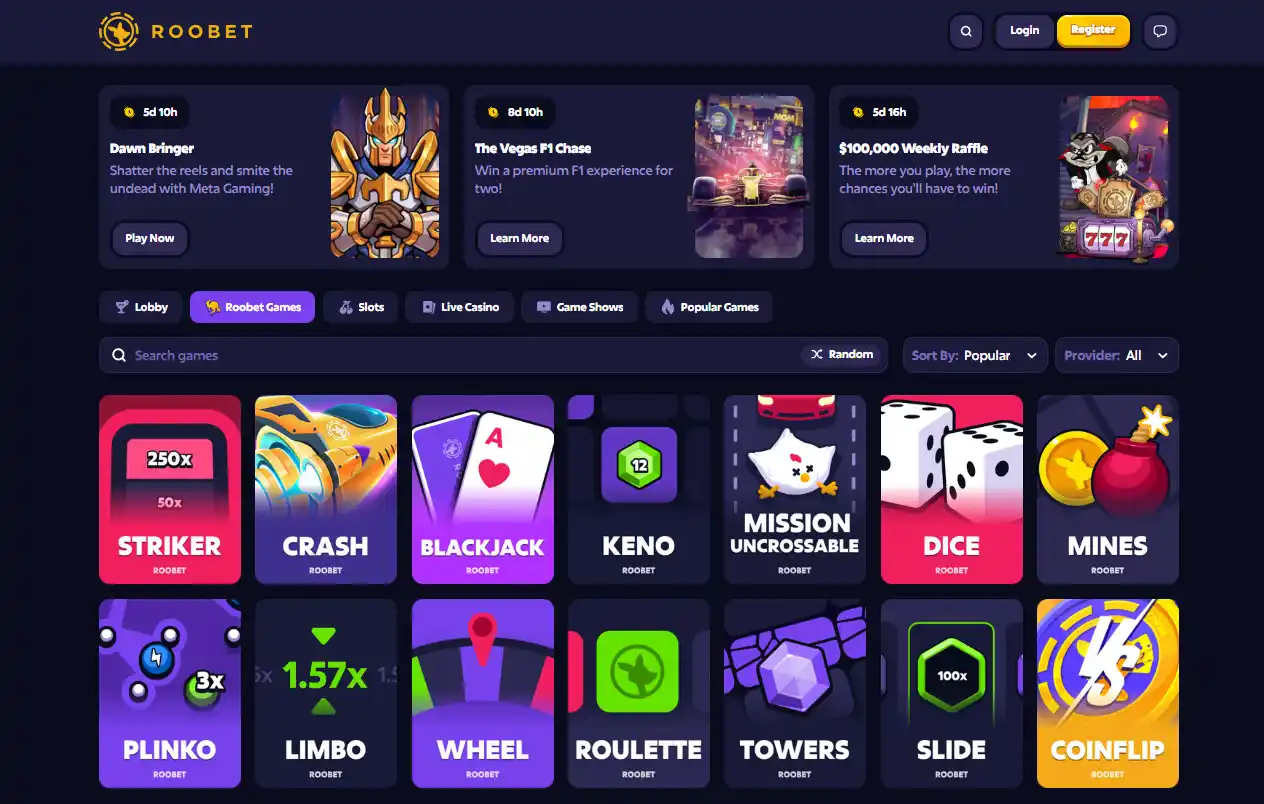
Roobet lists 12 Originals across several familiar game formats
The proprietary catalogue contains Crash, Blackjack, Limbo, Dice, Mines, Plinko, Towers, Roulette, Slide, Keno, Coinflip, and Mission Uncrossable. Crash is presented as a flagship Roobet Original, while Mission Uncrossable is described as an exclusive title.
- Originals12 games
- Flagship exampleCrash
- Exclusive titleMission Uncrossable
- Outcome featureProvably fair
| Original | Broad format cue | Useful reader question |
|---|---|---|
| Crash | Multiplier-style original | Do I understand the pace and the verification process before playing? |
| Blackjack | Card-game original | How does the proprietary version present the familiar game format? |
| Limbo | Target-style original | Can I separate the chosen target from the randomness of the result? |
| Dice | Number-based original | Can I reproduce the result check after the round? |
| Mines | Grid-style original | Do I understand that verification does not remove risk from each choice? |
| Plinko | Drop-style original | Can I distinguish visible animation from the underlying result verification? |
| Towers | Progression-style original | Am I treating each step as gambling exposure rather than guaranteed progress? |
| Roulette | Wheel-style original | Do I know which parts of the result can be checked afterward? |
| Slide | Proprietary original | Have I read the game rules before using the verification feature? |
| Keno | Number-selection original | Can I verify the draw process without assuming future outcomes? |
| Coinflip | Binary-outcome original | Do I understand that a simple format still carries variance? |
| Mission Uncrossable | Exclusive Roobet Original | Am I evaluating the game rules separately from its exclusive positioning? |
The table groups the games by broad interaction style. Roobet lists these 12 titles, presents Crash as a flagship Original, describes Mission Uncrossable as exclusive, and gives Originals a provably-fair verification layer. An audited RTP or house-edge figure is not stated here, so the verification feature should be read on its own terms rather than used as a substitute for missing return data.
For the wider catalogue beyond proprietary titles, the Roobet games guide separates Originals from third-party providers and the live casino section.
The Originals catalogue is easier to read when you separate game type from verification
Roobet Originals share a proprietary label, but they do not all create the same playing experience. A crash-style game, a card game, a grid game, and a number-selection game can place attention on very different decisions. Provably fair is therefore best treated as a verification layer that sits beside the game rules, not as a replacement for understanding those rules.
Game format tells you how decisions appear
Blackjack, Dice, Mines, Keno, and Crash present different choices and rhythms. Before thinking about verification, understand what action the interface asks you to take and what ending condition closes a round.
Verification tells you what can be checked afterward
A provably-fair process is useful when it gives you enough information to reproduce or validate an outcome. That check happens around the result-generation process; it does not tell you what the next result will be.
Risk remains part of every format
A verifiable result can still be a losing result. Cryptographic verification addresses one trust question, while bankroll risk, variance, and repeated play remain separate issues.
Use “provably fair” to answer a narrow question: can the game result be independently checked against the published verification process? Do not stretch it into a claim about profitability or future outcomes.
Provably fair is a reproducibility check on an outcome
At a high level, provably-fair systems use cryptographic inputs so a player can later verify that an outcome matches the committed data used for that round. The exact interface varies by game, but the underlying idea is consistent: the casino should not need to be taken on faith for the specific result if the relevant inputs and verification method are exposed.
- Play only after you understand the game rules and what information the interface exposes for verification.
- After a round, identify the values or records used by the game’s verification process.
- Use the provided verification method to reproduce or check the result against those values.
- Compare the calculated result with the result shown for the completed round.
- Treat a successful match as evidence about that round’s generation process, not as a forecast of what comes next.
This distinction matters because probability does not disappear when a process is transparent. A sequence of verifiable outcomes can still contain long losing runs. Verification helps answer whether the result corresponds to the committed inputs; it does not flatten variance or guarantee a particular return over a short session.
Verification does not supply missing RTP, house-edge, or safety guarantees
Roobet Originals have verifiable outcomes, but no audited RTP or house-edge figure is stated here. Those are different pieces of information. A player should not infer a mathematical return from the existence of a provably-fair mechanism.
What the feature can help establish
- The result can be checked against the game’s published verification process.
- The player can compare a completed round with the cryptographic inputs shown for that round.
- The verification step can reduce reliance on an opaque result screen.
What still needs separate judgment
- How much money to risk in a session.
- How volatile a specific game feels in practice.
- Any unpublished RTP or house-edge value.
- Whether continued play still fits a pre-set limit.
A useful mental model is to keep three questions separate: “Can I verify this outcome?”, “Do I understand the rules?”, and “Can I afford the risk I am taking?” Provably fair speaks mainly to the first question.
A simple routine makes the verification feature useful rather than decorative
The feature has more value when you actually know how to use it. Treat it as part of a repeatable post-round check, especially when trying an Original for the first time.
Before play
Read the rules and locate the game’s verification information.
After a round
Record or open the values used for that completed result.
Verification step
Reproduce the result with the method made available for the game.
Interpretation
A matching result supports the integrity of that round’s generation process; it does not predict another round.
If the verification flow is not clear to you, do not treat the label alone as sufficient explanation. The broader Roobet review covers the casino alongside payments, account checks, rewards, and trust signals so the Originals feature is not viewed in isolation.
There is also a practical difference between seeing a verification result and understanding it. A useful check should let you identify the completed round, locate the relevant cryptographic inputs, follow the stated verification method, and compare the reproduced result with what the game displayed. If one of those steps is unclear, the right response is to learn the verification flow before treating the feature as meaningful evidence. The process becomes most useful when it is repeatable: you should be able to perform the same kind of check on another completed round and understand why the comparison succeeds or fails.
That repeatability is the educational value of provably fair. It turns a vague trust label into a concrete procedure. It still does not answer every question about a game. Rules, volatility, session length, and personal spending limits remain separate decisions, so a player should use the verification check as one narrow tool inside a broader risk-aware approach.
Provably-fair verification does not make gambling low-risk. Keep a fixed spending limit and remember that crypto values can move independently of the game result.
Roobet Originals questions
How many Roobet Originals are listed?
Roobet lists 12 Originals: Crash, Blackjack, Limbo, Dice, Mines, Plinko, Towers, Roulette, Slide, Keno, Coinflip, and Mission Uncrossable.
Which Roobet Original is the flagship example?
Crash is presented as a flagship Roobet Original.
Is Mission Uncrossable a Roobet Original?
Yes. Mission Uncrossable is listed among the 12 Roobet Originals and is described as an exclusive title.
Are Roobet Originals provably fair?
Roobet Originals are described as having verifiable outcomes. The verification process can help check how a completed result was generated.
Does provably fair mean a game is profitable?
No. Provably fair addresses result verification. It does not remove variance, guarantee winnings, or provide an unpublished RTP or house-edge figure.
Read next
- Compare the wider Roobet games catalogue
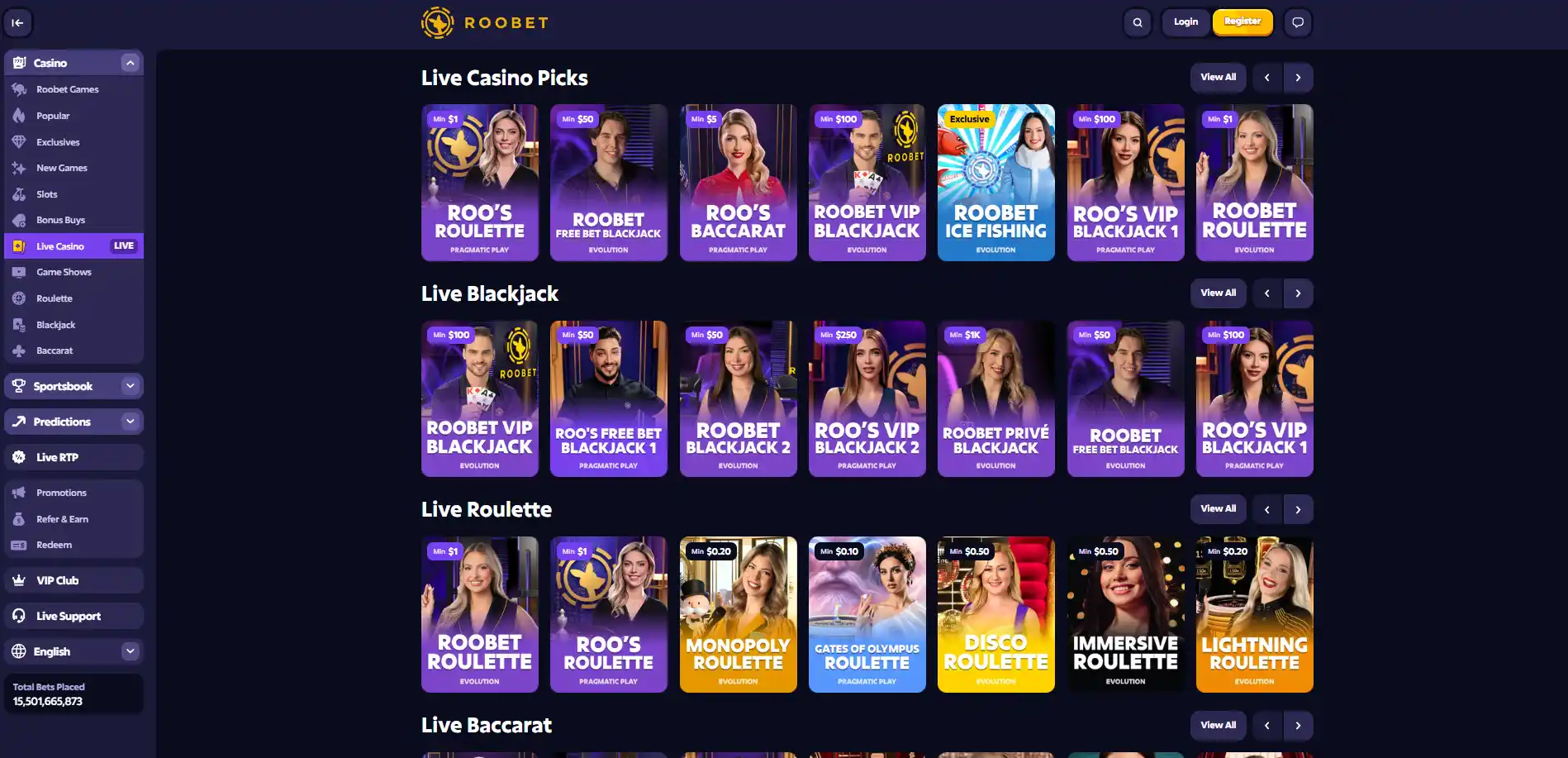
- See how live casino differs from Originals
- Return to the full Roobet review
Treat Roobet’s provably-fair layer as a check, not a promise
Roobet’s 12 Originals give the casino a distinct proprietary catalogue, with Crash as a flagship example and Mission Uncrossable as an exclusive title. The provably-fair element adds a useful verification layer because completed outcomes can be checked. Its value stays narrow, though: it verifies aspects of result generation and does not remove variance, supply missing mathematical return figures, or turn gambling into a predictable activity.
Created by the ”Roobet” editorial team.